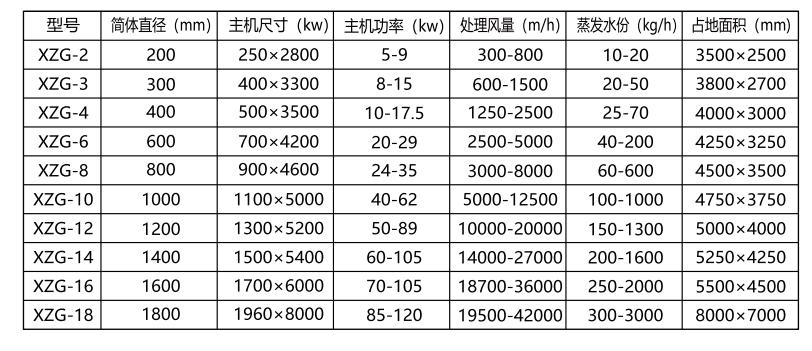
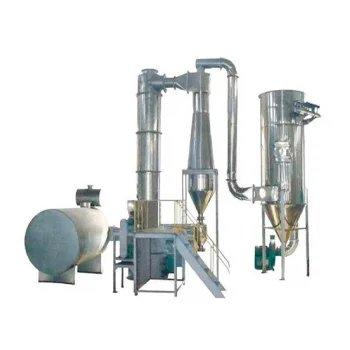
Image and performance characteristics of flash dryer:
The organic combination of cyclone, fluidization, jetting and crushing classification technologies.
The equipment is compact, small in size, and has high production efficiency, enabling continuous production and achieving "small equipment, large production"
It has high drying intensity, low energy consumption, and high thermal efficiency.
The material has a short residence time, resulting in good product quality, making it suitable for drying heat-sensitive materials.
Operating under negative pressure or micro-negative pressure, it boasts excellent sealing performance, high efficiency, and effectively eliminates environmental pollution.
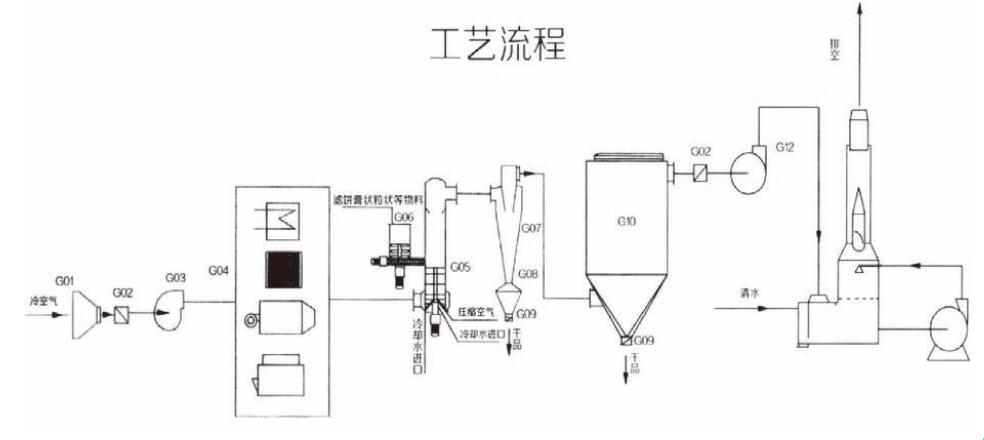
Working Principle:
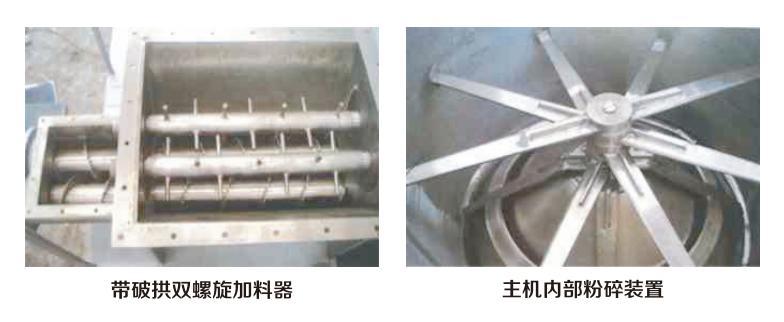
The hot air enters the bottom of the dryer tangentially and forms a strong rotating wind field driven by the agitator. The paste-like material enters the dryer through a spiral feeder and is dispersed under the strong impact, friction, and shear forces exerted by the high-speed rotating agitator blades. The lumpy material is quickly crushed, fully contacts the hot air, and is heated and dried. The dehydrated dry material rises with the hot airflow, and the classification ring traps the large particles. The small particles are discharged from the center of the ring out of the dryer and are recovered by a cyclone separator and dust collector. The unfinished or large pieces of material are thrown towards the wall by centrifugal force and fall back to the bottom for further crushing and drying.
Suitable crops
Organic compounds: Atrazine (pesticide insecticide), lauric acid, benzoic acid, benzoic acid, bactericidal agent, sodium oxalate, cellulose acetate, organic pigments, etc.
Inorganic substances: borax, calcium carbonate, hydroxides, copper sulfate, iron oxide, barium carbonate, antimony trioxide, various metal hydroxides, various heavy metal salts, synthetic cryolite, etc.
Dyes: anthraquinone, black iron oxide, indigo pigment, butyric acid, titanium hydroxide, zinc sulfide, various azo dye intermediates.
Food category: soy protein, gelatinized starch, distillers' grains, wheat sugar, wheat starch, etc.
Ceramics: kaolin, silica, clay